

May 8, 2026
CGP Adopts Position Paper:
Real Food for Every Child
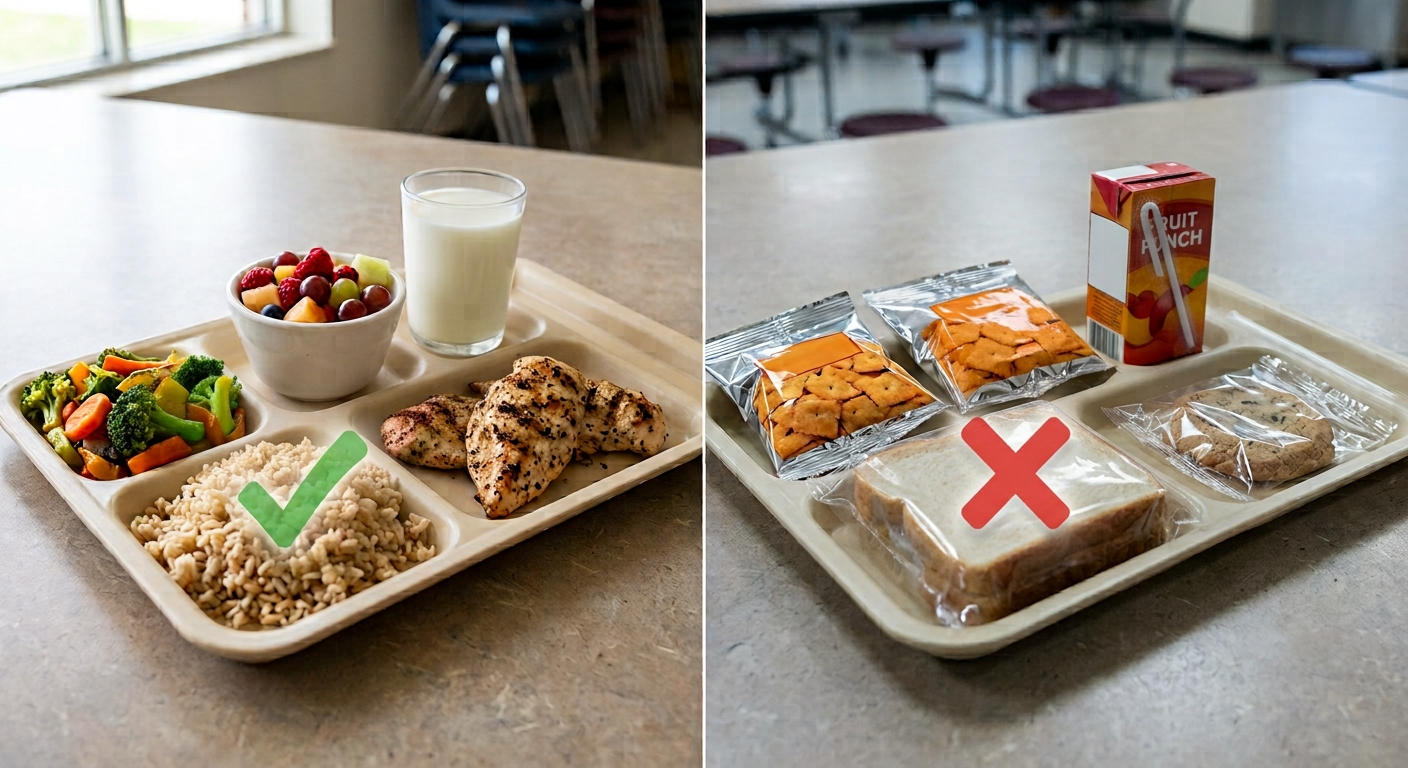
A UPF-Free National School Food Program
The federal government made the National School Food Program permanent through the National School Food Program Act, which received Royal Assent on March 26, 2026, and committed $216.6 million per year starting in 2029-30 to fund it. The Common Good Party welcomes this as an overdueand meaningful step. A child who is hungry cannot learn. A child who is fed industrial food products instead of real meals is not much better served.
The program as legislated is a foundation. It is not yet a standard. The federal announcement contains no binding mandate requiring meals to be free of ultra-processed foods, no requirement for organic sourcing, and no enforceable local food procurement targets. Food quality standards have been left largely to provincial and local interpretation, meaning the same federal dollars could fund a nutritious scratch-cooked meal in one province and a packaged, additive-laden product in another. The Common Good Party considers this unacceptable, and commits to fixing it.
The Problem With Ultra-Processed Food in Schools
Ultra-processed foods are industrial formulations made largely from refined ingredients and additives not typically found in home cooking. In Canada, they already make up nearly half of the daily calorie intake of children aged two and older — and for some children, that figure reaches 80 per cent. Canadians are the second largest consumers of ultra-processed foods and beverages in the world.
The health consequences are not abstract. A major Canadian study drawing on data from over 2,000 children found that higher ultra-processed food consumption among preschoolers was directly associated with anxiety, fearfulness, aggression, and hyperactivity by age five. Replacing just 10 per cent of energy from ultra-processed foods with minimally processed whole foods was associated with meaningfully better behavioural outcomes. Researchers have described ultra-processed foods as one of the most urgent yet inadequately addressed threats to human health in the 21st century. Children spend a significant portion of their waking hours at school. What they are fed there matters enormously — not only for their immediate concentration and learning, but for the dietary habits and health outcomes they carry into adulthood.
A publicly funded national school food program that serves ultra-processed food is not a health program. It is a subsidy for the industrial food industry at the expense of Canadian children.
What the CGP Will Do
The Common Good Party commits to the following when in government: Mandate UPF-free meals across the National School Food Program. Federal funding will be conditional on meals meeting a binding standard that excludes ultra-processed foods as defined by the NOVA classification system. Provinces and territories will retain flexibility in how they source and prepare food — but not in whether the food they serve meets this standard. Funding follows the standard.
Establish a national real food baseline. Working with nutritionists, public health experts, Indigenous food knowledge keepers, and provincial partners, the CGP will develop a clear, enforceable definition of what constitutes a qualifying meal under the program — one grounded in whole and minimally processed foods, reflective of Canada’s cultural diversity, and free from the additives, emulsifiers, and artificial flavourings that characterize industrial food products.
Prioritize local and regional food procurement. Federal agreements with provinces and territories will include progressively increasing targets for locally and regionally sourced ingredients, supporting Canadian farmers and food producers while reducing the supply chain vulnerabilities that make industrial food products so prevalent in institutional settings. Nova Scotia has already committed to sourcing at least 20 per cent of lunch program food from local suppliers — this should be a national floor, not an outlier.
Support the infrastructure to make it possible. Many schools lack the kitchen facilities and trained staff to prepare meals from scratch. The CGP commits to ensuring that a meaningful portion of National School Food Program funding is directed toward kitchen infrastructure, equipment, and food preparation training — so that the standard we set is one schools can actually meet.
Protect the program from corporate capture. The history of school food programs in other countries, most notably the United States, is a cautionary tale of what happens when industrial food service companies are allowed to shape institutional food standards in their own interest. The CGP will establish clear conflict-of-interest rules preventing ultra-processed food manufacturers and major industrial food service corporations from participating in the design, governance, or evaluation of the National School Food Program.
A Note on Jurisdiction
The CGP respects provincial jurisdiction over education. The National School Food Program operates through bilateral agreements with provinces and territories, and this will remain the case. What the CGP is proposing is not a federal takeover of school food — it is a condition attached to federal funding, which is entirely consistent with how federal transfers have always worked in Canada. Provinces that wish to access federal school food funding will be required to meet a real food standard. Those that exceed it will be recognized and supported.
Quebec’s asymmetrical arrangement under the program will be respected, and the CGP commits to working with the Quebec government to develop a compatible standard that reflects Quebec’s distinct food culture and existing school food infrastructure.
The Common Good Party believes that what a child is fed is not a partisan question. It is a question of what kind of country we are. A country that invests billions in feeding its children and then fills their plates with industrial food products has confused spending with caring. We intend to do both.